Earlier this year, I found Dr. APJ Abdul Kalam’s book, ‘Ignited Minds: Unleashing the power within India,’ at home. I hadn’t read a non-fiction book in a while, and I have deep respect for Abdul Kalam sir, so I thought I’d give it a go.
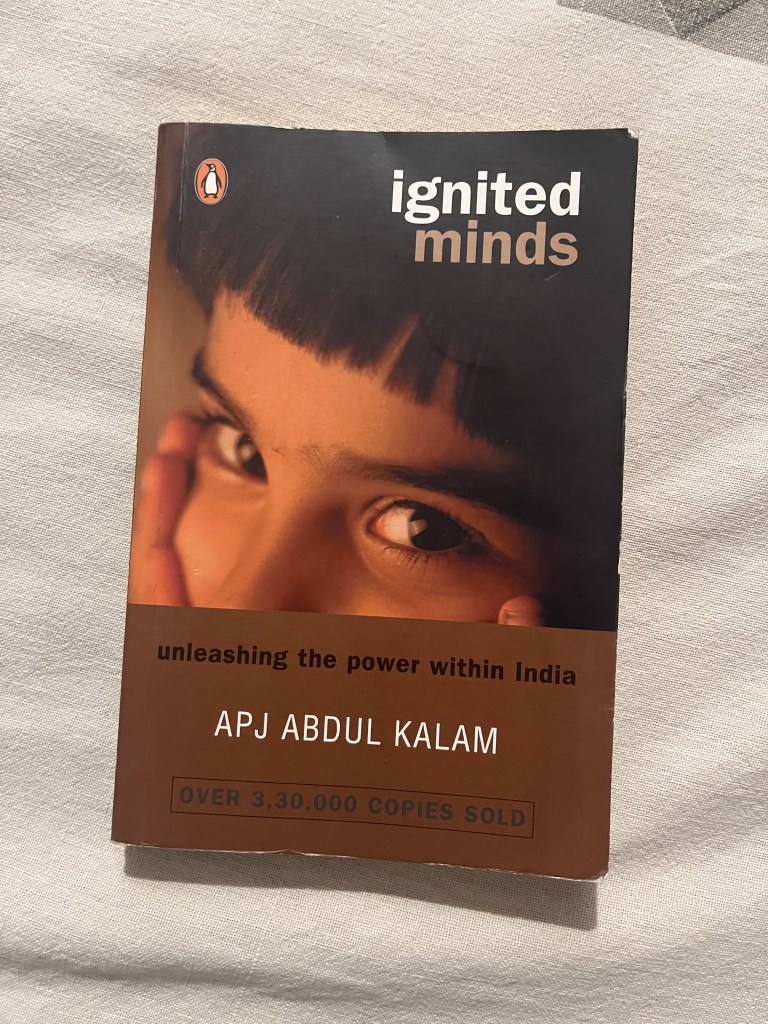
Abdul Kalam sir, as we all know, was a noble soul. He devoted his life towards the mission of developing India. A man like him does not walk this Earth often. I consider myself blessed that I come from a nation in which great men and women like him have come and gone.
Ignited Minds was an interesting book, but this essay is not a book review. You can find a sufficient number of reviews and summaries online. I’m writing this to give shape to some of the thoughts I had while reading this book, because I don’t want this to be just another book that has passed by my hands.
Can you dare to dream?
Kalam sir’s purpose behind writing this book was to inspire and mobilize the youth of our nation to dream big and take our nation to greater heights. A part of me felt regretful while reading this book. I wish I’d read it earlier, in high school or university, instead of now. Maybe if I read this book when I was still a student, I would have not wasted so much time and energy engaging with unfruitful thoughts, actions, or people. Trying hard to fit in with people who have gone off in completely separate ways, consuming pop culture and social media, gossiping and passing judgement on others, and wallowing in self pity because of social comparisons — things that took so much but gave nothing in return (except for maybe low self-esteem, anxiety, and confusion).
Throughout the book, Kalam sir asks us to wield the sword of our imagination and dream the most dreamiest dream we ever can. He asks us to develop a vision so strong that we get consumed by it and don’t look anywhere else. As I’ve grown older, my dreams have become more “realistic.” Like many of us, I grew up with a risk-averse mindset, and so the safest, most predictable path was what we defined as the path to success. We silenced the voices that told us we could win an Oscar or become a famous novelist. We condensed our dreams into quantifiable ‘goals’ and ‘milestones,’ and in the process, lost the forest for the trees.
But, it’s never too late to dream, is it? Reading this book reminded me of the adage, “Dare to dream.” To dream, freely and unapologetically, is a daring act. How many of us are ready to do that?
Let children dream
It becomes harder (but not impossible) to dream as you grow older and your responsibilities increase. That’s why it’s so so so important to encourage children to dream. This is one of my favorite quotes from the book:
‘There is no greater power than heaven or earth than the commitment to a dream.’
Children should be encouraged to dream, but along with that, they should also develop the belief that they can achieve their dreams. To enable children to develop a strong sense of self-belief, they need 1) role models and 2) good teachers.
We don’t need to look far and away to find role models. The sacred land of India has been the birthplace of great souls whose contributions have transformed every possible field, be it science, technology, philosophy, literature, art, spirituality — you name it. We need to tell children stories of the achievements of their ancestors. We need to make them aware of the richness of their heritage and civilization, and this is something I believe the post-independent Indian education system has failed in doing (more on that later).
It is also imperative for the education system to be built on the foundation of learning, not grades. The teacher is more important than the subject. As sir writes, “The teacher, the child’s window to learning and knowledge, has to play the role model in generating creativity in the child.”
Reading this reminded me of one my high school math teachers. I’ve never been very good at mathematics. Or if I have to be frank here, I absolutely sucked at that subject. I had my first ever math-induced breakdown in third grade, and these breakdowns continued until I formally studied the subject, that is, till twelfth grade. However, I will never forget this one math exam I gave in tenth grade in which I secured the second rank in my class. It was the first and last time something like this ever happened in the history of all the math examinations I’ve ever attempted. The credit for this achievement solely goes to the wonderful math teacher who taught me that semester. She is the only math teacher I’ve had who made me appreciate the subject for what it is, without fearing it. I’ll never forget her. Good teachers can change your life.
On education, Kalam sir writes, “Education and the teacher-student relationship have to be seen not in business terms but with the nation’s growth in mind.” Which takes me to the next part.
Be proud of your nation
Most of our dreams are individualistic in nature. We want wealth, luxury, pleasure, and abundance for ourselves and our loved ones… which, honestly, is not wrong. It’s good to want these things, in fact. People who sincerely work towards their individualistic goals are more respectable than the people who do nothing but complain about others achieving success.
But, how many of us dream of things bigger than ourselves? How many of us dream of social change, of India’s progress?
Kalam sir tells us that the nation is more important than the individual. That we need to think beyond ourselves and work towards making the nation great. Real success lies not in what you’ve achieved as an individual, but in how much you’ve helped others succeed.
I’m going to be very honest here and confess that my goals are mostly individualistic. I don’t think I have the courage (yet) to put my personal desires at the altar of something bigger. But, the least I can do is commit to learning about my nation, and more importantly, honoring it. Sir says, “Three factors are invariably found in a strong nation: a collective pride in its achievements, unity, and the ability for combined action.”
The post-independent Indian education system has failed to instill a sense of pride for the nation in its children. I, as did many people of my generation, grew up with the idea of India as a poor, underdeveloped, third-world nation, whose history has only been that of invasions and losses. We grew up believing that our ancestors were backward and orthodox, and let our identity be defined by the people who conquered us. “I am concerned about the inertia that has gripped the national psyche, the mindset of defeat,” is what sir writes in the preface of the book.
There’s an African proverb that says, “Don’t call the forest that shelters you a jungle,” which basically means – don’t disrespect that which nurtures or protects you. I’ve seen many people who unabashedly criticize our motherland, the same land that our ancestors so fiercely protected and worshipped. Yes, there are countless problems in this country, but that does not mean we constantly thrash and belittle it. (And more often that not, we are a part of the problem.) We owe at least some respect and gratitude to our nation. These words from the book really stuck with me – “The only way to show the strength of the country is the might to defend it.”
Anyway, I don’t want to risk sounding like a preacher who does not practice. Like I wrote before, the one step I can take right now is to commit to honoring my country. Learn more about its real history, appreciate the eternal wisdom of our scriptures, and think of ways in which I can help my brethren. We’re lucky that there exists an abundance of resources that we can access, something that previous generations didn’t have.
As I’ve said before, this is not a summary of the book – just a reflection of some of my thoughts. I was shuffling through the pages of the book after drafting this, and realized that there’s so much more to it than what I’ve written. If what I’ve written interests you, I would recommend that you read the entire book. There are multiple topics sir touches upon, from spirituality, to rural development, to the importance of knowledge creation.
If there’s one thing that I have taken away from this book, it is the importance of dreaming and nurturing our dreams. Kalam sir quotes the Yogasutras by Maharishi Patanjali – a beautiful quote that captures the power of a dream:
‘When you are inspired by some great purpose, some extraordinary project, all your thoughts break their bounds. Your mind transcends limitations, your consciousness expands in every direction, and you find yourself in a new, great, and wonderful world. Dormant forces, faculties, and talents become alive, and you discover yourself to be a greater person by far than you ever dreamed yourself to be.’
 tanvi's digital journal
Leave a comment